

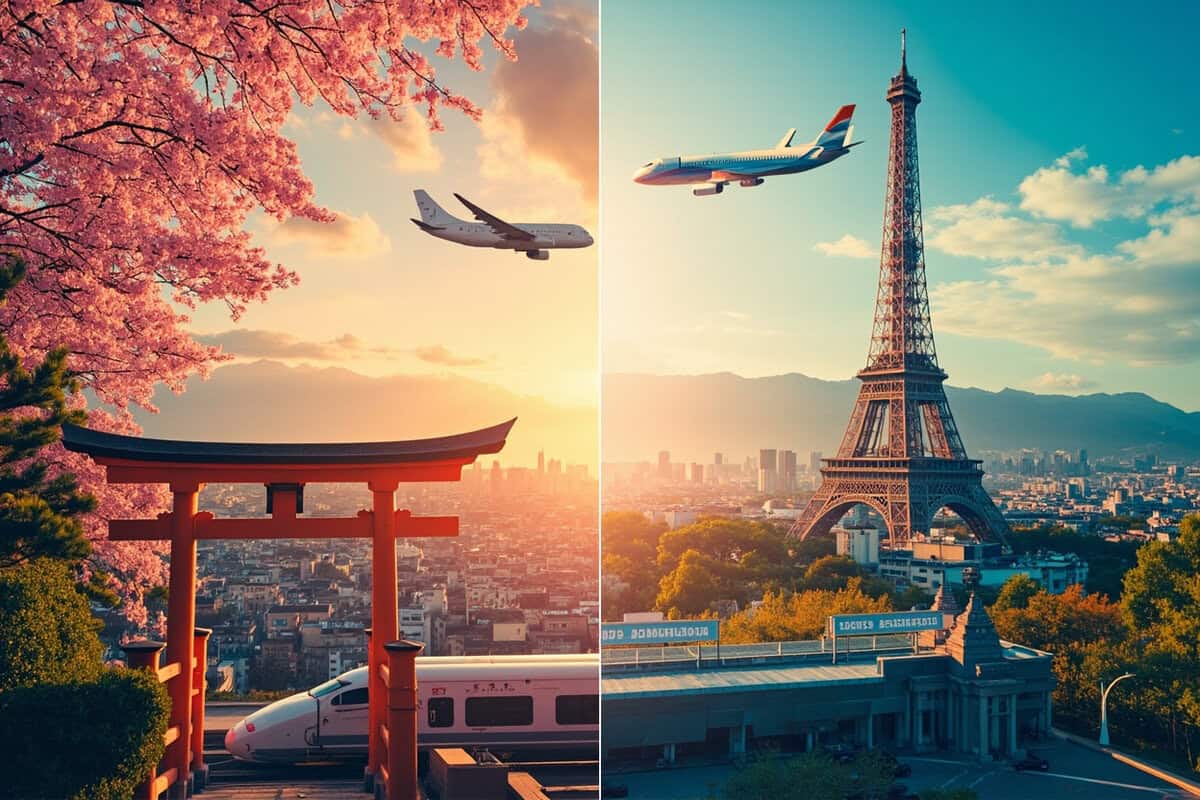
You have been saving. You have leave in the bank. And you keep going back and forth: Japan or Europe? Both check different boxes. Neither is clearly better. Here is the honest breakdown from a Singapore POV.
The Distance Reality
Japan: 5-6 Hours, Manageable Jet Lag
Japan is 5-6 hours from Singapore. Direct flights are plentiful. You land, you adjust, you go. Jet lag is manageable, usually one day to recover. You can do a 5-night trip and come back feeling like you actually rested.
Europe: 13-14 Hours, Plan for Recovery Time
Europe is 13-14 hours minimum to London or Paris. Add connections if you are not flying direct. Jet lag hits harder. A 5-night Europe trip is really 2 days recovering and 3 days sightseeing. Many Singaporeans come back more tired than when they left.
For short trips under 10 days, Japan wins on logistics alone.
Cost: What You Actually Pay
Japan has a reputation for being expensive. It is. But Europe is consistently more expensive in almost every category.
Flights
- Flights: Singapore to Japan: S$400-800 return. Singapore to Europe: S$1,200-2,500 return. The gap is significant.
Accommodation
- Accommodation: A decent business hotel in central Tokyo costs S$150-250/night. In Paris or London, S$250-450 for something comparable.
Food
- Food: Japan wins here. Sushi, ramen, yakitori, convenience store meals — eat very well in Japan for S$30-60/day. A burger and beer in Oslo costs S$35. The same meal in Osaka costs S$12.
Transport Within
- Transport within: Japan’s JR Pass covers bullet trains at a flat daily rate. In Europe, separate rail tickets between countries add up fast.
For a 10-day trip for two people: Japan S$6,000-10,000 all-in. Europe starts at S$12,000-18,000 for the same comfort level.
The Language Barrier
Japan: Easier Than You Think
Japan has a reputation for being hard for English speakers. It is not as bad as people think. Signs in major stations are bilingual. konbini culture means you are never stuck for a meal.
Europe: Mixed, Depends on Country
Europe is more mixed. Netherlands, Scandinavia, Germany — English is widely spoken. Rural France, Italy, Spain, Eastern Europe — it varies. You are pulling out Google Translate more often outside tourist areas.
Food: The Honest Comparison
Japan: Consistency and Value
Japan is a food destination. People travel to Japan specifically to eat and they are not wrong. Sushi, kaiseki, tonkotsu ramen, yakitori, wagyu beef, tempura, Japanese breakfast — the depth and consistency of great food in Japan is genuinely remarkable.
Europe: Variable But Exceptional
Europe also has extraordinary food. Italian pasta made fresh, French pastries, Spanish tapas, Swiss cheese, Belgian beer. But the average meal in Europe is more variable. Some countries (France, Italy) are consistently excellent. Others require more research to find the right spots.
If food is the primary motivation, Japan wins on pure consistency and value.
What Japan Does Better
Infrastructure, Safety, and Comfort
- Organised infrastructure — trains run on time, signage is clear, systems work
- Safety — walk anywhere at 2am without thinking twice, a wallet left on a train table will still be there in an hour
- Compact itineraries — Tokyo, Kyoto, Osaka in 2 weeks and feel like you covered real ground
- Cherry blossom and autumn seasons are genuinely life-changing
- Convenience store culture — bread, eggs, drinks, rice, cooked food at 7-Eleven means you are never stuck
- Clean, polite, efficient — there is a particular comfort in navigating a city that just works
What Europe Does Better
History, Architecture, and Long-Stay Value
- Historical depth — a single afternoon in the Louvre or walking the Roman Forum delivers more history than months in Asia
- Variety of experience — ski in the Alps, swim in the Mediterranean, eat in a 3-star Michelin restaurant in Paris in one trip
- Long-stay value — the longer you stay in Europe, the more sense it makes. A month renting an apartment in Portugal or Croatia makes financial sense.
- Visa-free for Singaporeans — 30 days for most European countries. No application process.
- Architectural beauty — Prague, Vienna, Barcelona, Florence — the urban landscape in European cities hits different
- Art and culture — museum density in Europe is unmatched. If this matters to you, Europe is not comparable.
Travelling With Kids: The Honest Comparison
Japan: Easier for Young Kids
Japan is significantly easier with children in the 4-12 age range. Here is why.
Japan loves kids. Really loves them. Theme parks, aquariums, animal cafes, capsule toy machines on every block — there is an endless supply of entertainment that does not require planning. Convenience stores have child-friendly food. Restaurants regularly have kids menus and booster seats. Most importantly, Japanese public transport is punctual and predictable — you can plan your day around reliable train schedules rather than hoping the bus shows up on time.
Europe: Better for Older Kids
European cities are less predictable. Tighter streets with more traffic, restaurants that are not set up for children, train connections that involve stairs and no lifts. Some countries (Germany, Netherlands, Scandinavia) are more family-oriented than others (France, Italy, Spain are more accepting of children in restaurants but less set up for them in practical ways). The museums in Europe are extraordinary but young kids do not care about the Louvre and you will be carrying a stroller up cobblestone streets.
Bottom Line for Families
If you have young children and are doing 7-10 days, Japan is the easier choice. The infrastructure works in your favour, the food is predictable, and there is enough variety in the experience to keep kids engaged. Our Taipei with kids itinerary covers how a city that is not Japan proper still delivers similar infrastructure reliability for families.
Europe shines with older children (10+) who can appreciate the history, museums, and architecture. A teenager who can engage with the Colosseum or the Eiffel Tower gets something real out of Europe that Japan cannot replicate. With young kids, Japan gives you fewer headaches and more quality time.
Who Should Pick Japan
Best For
- First international trip — manageable distance, easy to navigate, safe
- 5-10 days — Japan is the sweet spot where you cover meaningful ground without fatigue
- Budget travellers — Japan delivers high value at moderate cost
- Food-first travellers — if your trip is organised around meals, Japan is the better call
- Nature and seasons travellers — cherry blossom and autumn in Japan are genuinely in a different category
- If you have been to Europe before — Japan offers a completely different travel experience that complements what Europe offers
- Travelling with young children — Japan is easier for kids under 12
Who Should Pick Europe
Best For
- 14+ days available — Europe needs time to breathe
- History and culture first — museums, architecture, ancient cities are your priority
- Multi-country ambitions — you want to visit 4 countries in one trip
- Specific bucket list items — Eiffel Tower, Colosseum, Santorini sunset, London theatre
- European heritage — if you have family roots in Europe, there is no substitute for going
- Planning a longer stay (2+ months) — long-term Europe has better value than Japan for that timeframe
- Teenagers who can engage with history and culture — Europe delivers for older kids in a way Japan cannot match
The Honest Verdict
The Short Trip Case: Japan
For most Singaporeans with limited leave, Japan is the better investment of a 2-week holiday. It is closer, cheaper, easier to navigate, and delivers at every level — food, safety, transport, experience.
The Long Trip Case: Europe
Europe is the better choice when you have more time, want a deeper cultural experience, or have specific bucket list items that only Europe can deliver.
Common Mistakes to Avoid
The mistake most people make is going to Europe for a short trip and feeling like they did not get enough out of it. Or going to Japan and spending so much they wonder if they should have just gone to Europe. Match the trip length to the destination and you will not go wrong with either.
Start Planning
Ready to pick Japan? See our Elephant Mountain hiking guide for a taste of what a Taipei add-on day looks like. Or jump straight into our Gili Islands guide if Bali or Lombok is the next destination on your list.
0 comments